

Something is shifting quietly but powerfully in how India’s younger generation chooses to travel. On any given Friday evening at Delhi’s Kashmere Gate ISBT or Anand Vihar bus terminal, the faces boarding overnight buses to Haridwar, Rishikesh, and Varanasi are not the ones you might have expected a decade ago. They are in their twenties and early thirties, backpacks slung casually, earphones around their necks, phones open not to party playlist apps but to Ganga Aarti livestreams and trek route maps. Delhi is witnessing a quiet but unmistakable pilgrimage travel revolution — and its loudest voices belong to millennials and Gen Z.
The Numbers That Tell the Story
The data speaks with remarkable clarity. According to the Ixigo Great Indian Travel Index 2025, bus bookings to Haridwar surged by 73 per cent year-on-year, while Rishikesh recorded 81 per cent growth — both among the fastest-growing pilgrimage routes in the country. Across all modes of transport, searches for Haridwar, Rishikesh, and Dehradun grew by 60 per cent year-on-year, according to Cleartrip’s travel trends tracker PeekABoo.
Perhaps most telling is who is driving these numbers. Gen Z now makes up 12 per cent of Haridwar and Rishikesh bookings — a figure that has grown 15 per cent year-on-year, according to Cleartrip’s Chief Growth Officer Manjari Singhal. In Rishikesh specifically, Zostel’s 2025 data reveals that Gen Z accounted for 59 per cent of all visitors, with millennials adding another 38.3 per cent. In practical terms, that means nearly the entire footfall at one of India’s most sacred river towns now comes from travellers under the age of 40.
The redBus 2025 Travel Trends Report paints the broader picture. India saw 88 per cent overall growth in pilgrimage tourism compared to 2024. Comfort preferences have shifted too — 73 per cent of all intercity bus bookings are now for AC buses, and sleeper seats account for 50 per cent of sales. Young travellers are not roughing it to the ghats; they are arriving rested, intentional, and ready to experience.
Why Young Delhi Travellers Are Choosing the Sacred Over the Scenic
This is not a passing trend. It reflects a genuine reorientation in values among urban young people who have grown up overstimulated, over-connected, and quietly exhausted by the relentless pace of digital life.
Travel researchers and sociologists have begun describing this phenomenon as the rise of “shrinecations” — trips that blend ancient pilgrimage routes with boutique stays, local food trails, and a deep appetite for authenticity. According to Outlook Traveller, Rishikesh and Haridwar remain the perennial favourites on this circuit, beloved for their “serene retreats” where spirituality, culture, and landscape converge.
For many young Delhiites, a weekend bus ride to the Ganga represents something no beach resort or hill station can offer: the rare sensation of feeling genuinely small in the presence of something ancient and vast. They are not simply checking temples off a list. They want to sit on a ghat at dawn, watch mist rise off the river, share prasad with strangers, and return to Monday feeling recalibrated in a way that no vacation abroad quite manages.
The accessibility of the route helps enormously. Delhi to Haridwar is barely 215 kilometres — a four to five hour journey on a comfortable overnight bus that drops travellers directly into the heart of one of Hinduism’s holiest cities. No flights to book, no airports to navigate, no international currency to arrange. Just a bus ticket, a weekend, and the Ganga waiting at the end of it.
Haridwar: The Gateway That Never Closes
For first-time spiritual travellers from Delhi, Haridwar invariably becomes the entry point — and for many, the destination that demands a return.
The city sits at the precise point where the Ganga descends from the Himalayas and touches the plains of northern India, and this geography gives it an energy that is genuinely unlike anywhere else. Har Ki Pauri, the most sacred ghat, is where thousands gather every evening for the Ganga Aarti — a ceremony in which brass lamps are raised to the river in an act of gratitude so luminous and collective that even the most sceptical traveller tends to fall quiet.
Beyond the aarti, Haridwar rewards exploration. The narrow lanes of the old town are lined with sweet shops selling petha and jalebi, flower stalls preparing offerings for the river, and small temples tucked into corners that a casual visitor might walk past without noticing. The Mansa Devi and Chandi Devi temples perch on the Shivalik hills overlooking the city, accessible by cable car or on foot for those who prefer to walk. Rishikesh is just 25 kilometres upstream, opening the door to yoga ashrams, the famous Laxman Jhula, riverside cafes, and whitewater rafting — making the twin-city circuit a near-perfect weekend itinerary.
Where to Stay: Evaara by the Ganges
For young travellers who want to experience Haridwar’s sacred energy without sacrificing comfort, Evaara by the Ganges has quietly established itself as one of the most thoughtful and beautiful places to stay in the region.
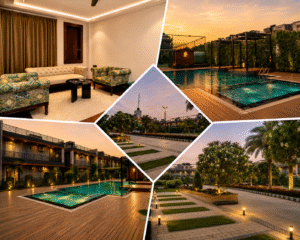
Situated along the Chilla Range near Rajaji National Park, roughly 10 kilometres from Haridwar city centre, Evaara is a 4-star riverside resort built directly on the banks of the Ganga. What immediately sets it apart is its private Ganga ghat— a dedicated stretch of riverbank where guests can step down to the water’s edge at any hour, whether to meditate in the early morning mist, take a ritual dip, or simply sit and watch the river move through the forest.
The resort offers five room types designed to suit different group sizes and budgets. The signature Sunset Ganga Heritage Suite is a spacious 810 sq ft three-bedroom home at the heart of the property, facing the river directly and accommodating up to six adults — perfect for a group of friends from Delhi making the trip together. The Premium Two Bedroom and Premium One Bedroom options offer quieter, more private retreats tucked toward the back of the property, ideal for couples or solo travellers seeking stillness.
Every room is air-conditioned, finished with rainfall showerheads, LED televisions, and private balconies where the sound of the Ganga replaces the city hum that most guests are trying to leave behind. The on-site restaurant Sattva Rasaserves vegetarian cuisine in a warm, carefully designed space — appropriate to Haridwar’s sattvic food culture. An outdoor swimming pool, landscaped gardens, a game zone, BBQ grills, and concierge services round out the amenities.
The location inside the national park zone is itself a draw. Guests wake to birdsong rather than traffic, and jungle safaris into Rajaji National Park can be arranged directly through the property. Tripadvisor reviewers consistently highlight the private ghat and evening aarti as the defining experiences of a stay here — moments that, as one guest put it, combine “a serene, spiritual touch” with the kind of unhurried luxury that makes you want to extend your checkout by another day.
For young Delhi travellers arriving on a Friday night bus and leaving Sunday evening, Evaara offers exactly the right rhythm: arrive, exhale, walk to the river, eat well, sleep deeply, and return to the city carrying something quieter and more lasting than a souvenir.
The Bigger Picture: A Generation Reclaiming Meaning
India’s spiritual tourism sector is projected to reach $59 billion by 2028, and the engine behind that growth is not an older, more traditionally devout demographic. It is a generation of urban young people — many of them from Delhi — who have discovered that the most radical thing they can do in a world of infinite digital stimulation is board a bus to a riverbank and simply be present.
The routes are ancient. The buses are air-conditioned. The ghats are unchanged. And the Ganga, as it has always done, keeps flowing.