When the Sticks Strike and the Circle Begins, India Comes Alive
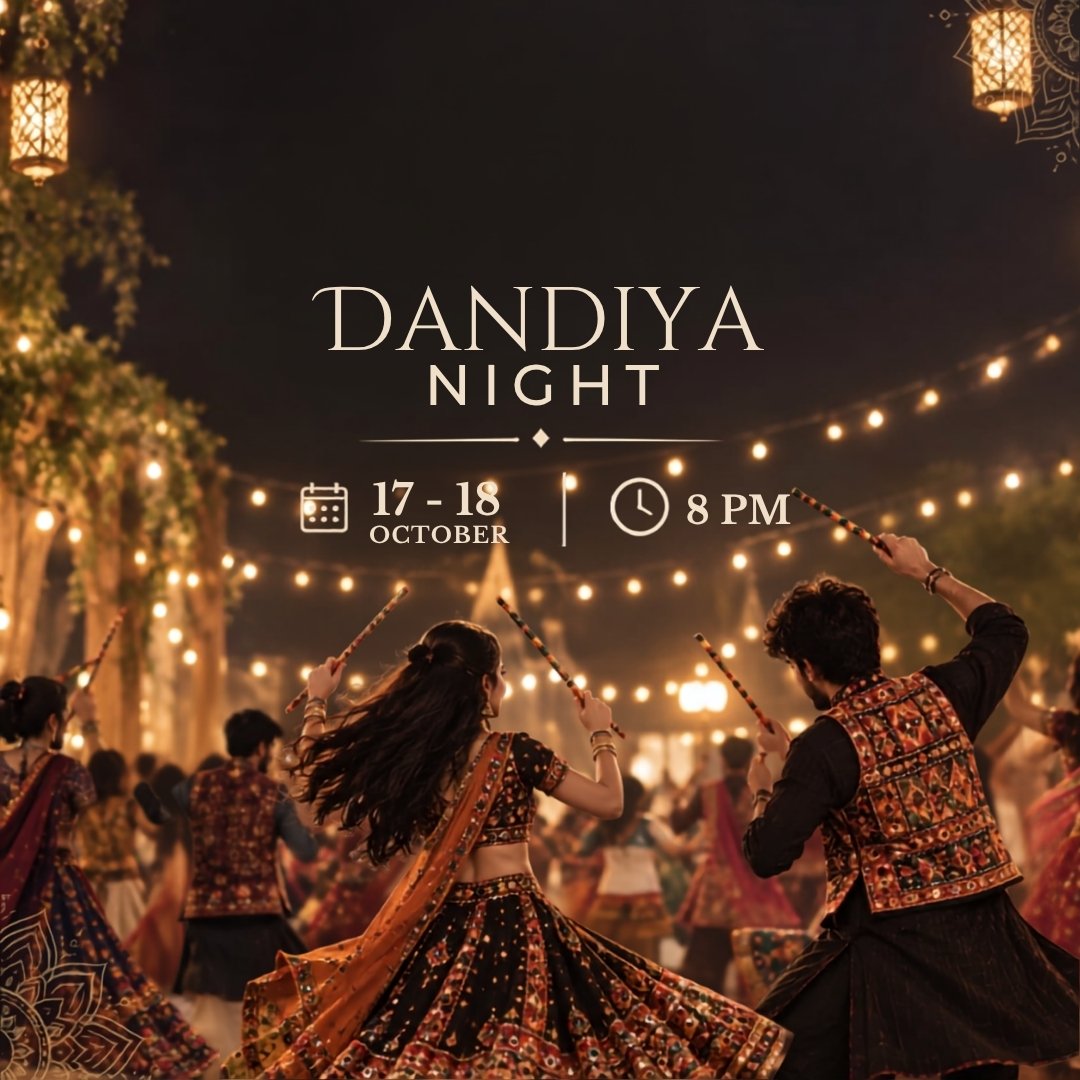
There is a moment — just before the music begins — when thousands of people stand in concentric circles, colorful sticks in hand, eyes bright with anticipation. Then the dhol strikes its first beat, the shehnai wails its opening note, and everything explodes into movement, color, laughter, and pure, unbridled joy.
That moment is Dandiya Raas — and there is nothing quite like it anywhere in the world.
Rooted in the fertile soil of Gujarat, nurtured by centuries of devotion to Goddess Durga and Lord Krishna, and celebrated today across every continent, Dandiya Raas is not simply a dance. It is a living tradition — a rhythmic conversation between the human spirit and the divine, expressed through swirling skirts, clashing sticks, and the kind of communal joy that dissolves all boundaries.
As Navratri 2025 approaches, the countdown to Dandiya season has truly begun. This is your complete guide to understanding, celebrating, and deeply appreciating one of India’s most vibrant and beloved cultural traditions.
What is Dandiya Raas?
Dandiya Raas is a traditional folk dance originating from the state of Gujarat in western India. The name comes from two words — Dandiya, meaning “sticks,” and Raas, meaning “dance” or “play.” Together, they describe a partner-based, circular dance performed with decorated wooden sticks that are rhythmically struck together to create a percussive musical pattern.
Traditionally performed during the nine sacred nights of Navratri, Dandiya Raas is deeply intertwined with the worship of Goddess Durga and the celebration of her victory over the demon Mahishasura. In some regional traditions, the sticks symbolize the sword of Goddess Durga, and every strike represents the battle between good and evil.
In the Vaishnava tradition, Dandiya Raas is associated with the divine love play (Raas Leela) of Lord Krishna and Radha in Vrindavan — a cosmic dance of devotion, beauty, and spiritual union.
What makes Dandiya Raas truly extraordinary is its democratic nature — it belongs to everyone. Young and old, men and women, beginners and experts — all dance together in joyful, rotating circles, striking sticks with their partners before moving to the next. In those circles, there are no hierarchies, no barriers — only rhythm, energy, and shared celebration.
The Spiritual Roots of Dandiya Raas
Navratri: The Nine Sacred Nights
Dandiya Raas finds its most sacred expression during Navratri — literally “nine nights” — one of the most important Hindu festivals celebrated twice a year, with the Sharad Navratri (autumn Navratri) in September–October being the most prominent.
During these nine nights, each day is dedicated to a specific form of Goddess Durga — from Shailputri on the first night to Siddhidatri on the ninth. The festival celebrates the triumph of divine feminine energy (Shakti) over evil, and culminates in Vijayadashami (Dussehra) — the day of ultimate victory.
Dandiya Raas is performed each evening of Navratri as an offering to the goddess, an act of devotion expressed not through silence but through joyful, energetic movement. The dance is believed to please the goddess and invite her blessings upon all who participate.
The Nine Forms of Goddess Durga Worshipped During Navratri
| Day | Goddess Form | Significance |
|---|---|---|
| Day 1 | Shailputri | Daughter of the mountains, new beginnings |
| Day 2 | Brahmacharini | Devotion and penance |
| Day 3 | Chandraghanta | Courage and grace |
| Day 4 | Kushmanda | Creation and cosmic energy |
| Day 5 | Skandamata | Motherhood and power |
| Day 6 | Katyayani | Warrior form, bravery |
| Day 7 | Kalaratri | Destruction of evil |
| Day 8 | Mahagauri | Purity and peace |
| Day 9 | Siddhidatri | Spiritual fulfillment |
Garba vs. Dandiya Raas: Understanding the Difference
Many people use Garba and Dandiya interchangeably, but they are two distinct dance forms that complement each other beautifully during Navratri celebrations.
| Aspect | Garba | Dandiya Raas |
|---|---|---|
| Meaning | “Womb” — symbolizing life | “Stick Dance” |
| Props | No props — only hand gestures and claps | Decorated wooden sticks |
| Timing | Performed before the aarti — as worship | Performed after the aarti — as celebration |
| Nature | Devotional and meditative | Energetic and festive |
| Formation | Circular, around the goddess idol or lamp | Circular partner-rotation format |
| Movement | Flowing, graceful, rhythmic | Percussive, fast-paced, dynamic |
| Spiritual Role | Offering to the goddess | Celebration of the goddess’s victory |
In essence: Garba is the prayer. Dandiya Raas is the celebration. Together, they form the complete spiritual and cultural experience of Navratri.
The Music That Moves the Dance
No Dandiya Raas is complete without its music — the sonic heartbeat that drives every spin, every strike, and every joyful moment on the dance floor.
Traditional Instruments:
- Dhol — The deep, resonant drum that sets the primary rhythm and tempo
- Tabla — Pairs with the dhol for intricate rhythmic patterns
- Shehnai — A wind instrument whose melodic wail adds a spiritual, haunting quality
- Manjira — Small cymbals that create the bright, tinkling percussion layer
- Harmonium — Provides the melodic base for devotional and folk songs
Traditional Song Types:
- Taal — Rhythmic compositions that guide the speed of dancing
- Raas Garba songs — Devotional folk songs praising Goddess Durga and Radha-Krishna
- Bhajans — Spiritual hymns woven into the musical program
- Folk melodies — Regional Gujarati compositions passed down through generations
Modern Musical Evolution:
Contemporary Dandiya celebrations have embraced fusion music, blending traditional folk with:
- Bollywood beats and remixes
- Electronic dance music (EDM) and DJ sets
- Fusion of classical ragas with modern production
- Collaborative works by artists like Falguni Pathak — widely regarded as the “Queen of Dandiya”
Popular Dandiya & Garba Classics:
- “Chogada Tara” (Loveyatri)
- “Dholida” (Gangubai Kathiawadi)
- “Nagada Sang Dhol” (Ram-Leela)
- “Kamariya” (Stree)
- “Maine Payal Hai Chankaai” (Falguni Pathak)
- Traditional “Jay Amba” and “Jai Ambe Gauri” devotional compositions
The Iconic Dandiya Sticks
The sticks used in Dandiya Raas are far more than simple props — they are an essential element of the tradition, carrying both spiritual symbolism and aesthetic beauty.
Types of Dandiya Sticks:
- Traditional bamboo sticks — Simple, lightweight, and authentic
- Decorated wooden sticks — Painted in bright colors with traditional Gujarati folk art patterns
- Mirror-work sticks — Adorned with tiny mirrors that catch and reflect light
- Velvet and fabric-wrapped sticks — Soft, colorful, and intricately designed
- Metallic sticks — Modern, shiny versions popular at large events
How to Hold & Strike:
- Hold one stick in each hand, gripping firmly but lightly
- Strike with your partner’s stick — not too hard, not too soft
- Maintain the rhythm aligned with the music’s beat
- As you rotate in the circle, adjust your striking pattern with each new partner
Stick Etiquette:
- Always strike sticks, not hands
- Be mindful of younger or elderly partners — reduce force accordingly
- Keep sticks at chest height for comfortable striking
- Replace worn or splintered sticks immediately for safety
Traditional Dandiya Costumes: Dressing the Celebration
The visual splendor of Dandiya Raas is inseparable from its extraordinary costumes. Dressing authentically for Dandiya is an experience in itself — a joyful immersion in Gujarat’s rich textile and craft heritage.
Women’s Traditional Attire:
Chaniya Choli (Lehenga Choli) The quintessential Dandiya outfit for women features:
- Chaniya — A full, flared skirt in rich fabrics like silk, georgette, or cotton, with elaborate embroidery, mirror work (Shisha), and colorful block prints
- Choli — A fitted blouse with intricate needlework, often in a contrasting color
- Dupatta — A long decorative scarf worn draped over the shoulder
Traditional Crafts Featured:
- Bandhani (tie-dye) — Iconic Gujarati textile art
- Patola — Double ikat weaving technique from Patan, Gujarat
- Kutchi embroidery — Elaborate needlework with mirrors and vibrant thread
- Zari work — Gold and silver thread embroidery
Jewelry:
- Maangtika (forehead ornament)
- Jhumkas (bell-shaped earrings)
- Nath (nose ring)
- Bangles — Stacked, colorful glass or metal bangles
- Kamarband (waist belt)
- Payal (anklets) — Their jingling sound adds a musical layer to the dance
Men’s Traditional Attire:
- Kediyu — A traditional short, flared top unique to Gujarati folk costume
- Dhoti or Churidar — Paired with the kediyu in white or bright colors
- Pagdi (Turban) — Vibrant Rajasthani or Gujarati-style headwear
- Mojdi — Traditional embroidered footwear
Colors: Men’s outfits typically feature bold, bright colors — saffron, royal blue, emerald green, and deep red — often with gold embroidery and mirror work.
Basic Dandiya Steps: A Beginner’s Guide
Never danced Dandiya before? Here is a simple breakdown to get you started:
The Foundation: The Basic Three-Step
- Stand facing your partner in a circle formation
- Hold one stick in each hand at chest height
- Step to the right on beat 1, bring feet together on beat 2, step right again on beat 3
- Strike your partner’s right stick on beat 1, left stick on beat 2, both sticks on beat 3
- After three beats, rotate to your left to face the next partner and repeat
Common Dandiya Patterns:
Dodhiyu — The most basic pattern where partners strike each other’s sticks twice in alternating sequences. Perfect for beginners and slower music.
Trikoniya — A triangular three-point striking pattern where three dancers form a triangle and rotate through a sequence of strikes. Slightly more advanced and incredibly satisfying to execute.
Hudo — A high-energy, fast-paced pattern popular in competitive Dandiya events. Involves rapid strikes and quick partner rotations — best attempted after mastering the basics.
Tran Taali — A three-clap sequence blended with stick striking, often used in transitional sections of the music.
5 Tips for First-Time Dancers:
- Listen first — Absorb the rhythm of the music before joining the circle
- Watch the experienced dancers — Stand at the outer edge and observe the patterns
- Start slow — Join during slower musical sections and build your confidence
- Smile and relax — Dandiya is about joy, not perfection
- Ask for guidance — Experienced dancers are almost always happy to help newcomers
Dandiya Raas Across India and the World
Regional Celebrations in India:
Gujarat — The Heartland The most authentic and elaborate Dandiya celebrations happen in cities like Vadodara, Ahmedabad, Surat, and Rajkot. The Vadodara Garba is internationally recognized for its scale, authenticity, and artistic excellence.
Mumbai The financial capital transforms during Navratri with massive community events at grounds like Filmistaan, NESCO, and housing society courtyards. Bollywood celebrities regularly attend and participate.
Saurashtra & Kutch These regions maintain deeply traditional, rural Dandiya celebrations where ancient folk songs, instruments, and customs remain largely unchanged — offering the most authentic experience.
Rajasthan With its cultural proximity to Gujarat, Rajasthan celebrates Dandiya with its own regional flavor — incorporating local folk music and Rajasthani costumes into the celebration.
Global Celebrations:
Dandiya Raas has truly gone global, with vibrant celebrations held in:
- United States — New York, New Jersey, Chicago, Houston, and San Francisco
- United Kingdom — Leicester, London, and Birmingham
- Canada — Toronto and Vancouver
- Australia — Melbourne and Sydney
- Middle East — Dubai and Abu Dhabi
- Southeast Asia — Singapore and Malaysia
The global Indian diaspora has carried this tradition to every corner of the world, making Dandiya Raas one of the most internationally celebrated folk dance traditions.
How to Celebrate Dandiya Raas Authentically
Before the Event:
- Dress in traditional Gujarati attire — the costume is part of the celebration
- Purchase or borrow a quality pair of Dandiya sticks in advance
- Practice basic steps at home to feel comfortable on the dance floor
- Learn at least one or two devotional songs to sing along during Garba
During the Event:
- Begin with Garba (the devotional portion) before moving into Dandiya Raas
- Participate in the aarti before dancing begins — it sets the spiritual tone
- Rotate gracefully through the circle, striking sticks with warmth and rhythm
- Encourage beginners around you — community spirit is at the heart of Dandiya
After the Celebration:
- Participate in the prasad distribution — blessed food offered after the aarti
- Take a moment to reflect on the spiritual significance of the nine nights
- Share your experience with those who couldn’t attend — the joy of Dandiya multiplies when shared
Navratri 2025: When to Celebrate
Navratri 2025 dates: September 22 – October 1, 2025
- Day 1 (Pratipada): September 22, 2025
- Day 9 (Navami): September 30, 2025
- Vijayadashami (Dussehra): October 2, 2025
Mark your calendar, prepare your outfit, and get your sticks ready — the most colorful nine nights of the year are approaching!
Preserving the Tradition for Future Generations
As Dandiya Raas continues to grow in popularity worldwide, its authentic cultural and spiritual essence must be carefully preserved and passed forward.
How to Be a Cultural Ambassador of Dandiya:
- Learn the traditional steps before fusion or modern variations
- Understand the spiritual context — teach children about Navratri’s religious significance
- Support local artisans who create traditional costumes, jewelry, and sticks
- Choose authentic music — include traditional folk compositions alongside modern favorites
- Document and share stories of how Dandiya was celebrated in your family’s tradition
The beauty of Dandiya Raas lies in its ability to evolve while remaining rooted — to embrace the new while honoring the ancient. This balance is what has kept it alive, vibrant, and deeply loved across generations and geographies.
Conclusion: Join the Circle, Feel the Joy
Dandiya Raas is an invitation — to step away from the ordinary, to lose yourself in rhythm, to connect with something ancient and sacred, and to rediscover the pure, uncomplicated joy of celebrating life together.
Whether you are a Gujarati who grew up with this tradition woven into the fabric of your childhood, a young person experiencing it for the first time, or a curious traveler drawn by the irresistible energy of the spinning circles and clashing sticks — Dandiya Raas will move you. Literally and spiritually.
This Navratri, let the sticks strike, let the music rise, let the circle begin.
Because when Dandiya calls, the only right answer is to dance.